In the world of wine, the concept of terroir describes a centuries long process in which the climate, soil, grape varieties and dedicated vintners, symbiotically develop a unique “sense of place” for a wine region. A favourite of mine, the garrulous and quintessential Californian vintner, Randall Grahm, while trying to establish the old World notion of terroir in California postulates that it is a long term proposition and can take centuries to develop.
As both a wine lover and serial tech entrepreneur, I firmly believe that building a tech cluster is similarly a very long term process. Ironically, the epicentre of tech clusters is in California. The Silicon Valley, which got its start in the 1950s remains the major cluster worldwide as “… no other place as yet has the Valley’s scale and resilience.”
Although I started my tech startup career in the US, it was in the Canada’s leading tech cluster of Waterloo where I built major companies and was one person who got that cluster started. Like Silicon Valley’s origins in Stanford University, the Waterloo cluster was initially fuelled by University of Waterloo. Over time, a combination of executive and programming talent, capital and professional services capabilites led to the current state of almost 1000 technology companies. By contrast to Silicon Valley, Waterloo is a must younger cluster, having started just over 25 years ago compared to the 60 years of Silicon Valley. It continues to mature around some key ingredients such as global strategic marketing capabilities and sufficient capital to fund on a globally competitive basis. Experienced people may well be the most important ingredient in a cluster’s maturation.
Further, I feel that all who have been fortunate to build wealth and experience in business, owe an obligation to “pay it forward” to the next generation. My own contributions include significant startup mentoring, Board and strategic roles in organizations like Communitech and Innovation Guelph, and for the last 3 years a Board role and chairing Selection Committee for the Golden Triangle AngelNet (GTAN). In just 3 years, GTAN has grown to about 150 paid accredited investor members who bring a wealth of experience to the 25 funding transactions to date. And, it goes without saying, that many of those financings might not have happened without GTAN having emerged to fill a significant funding gap as VC’s became largely extinct. Acting as a superangel to syndicate angel network deals is a tremendously labour intensive exercise, but one that I and others believe will pay off in the long term economic prosperity of our region.
I firmly believe knowledge-based companies to be the key ingredient of our future economic prosperity, so such company-building competence is mission critical for our region, province, country and globally. As globalization occurs, we see more and more regions clambering to reap the riches of the innovative, tech startup world.
To that end, at Verdexus, we have always taken a transatlantic perspective, primarily to have a more global window on building companies that can achieve world leadership in their chosen businesses. Over the years, I’ve worked with startups across the United States and Europe in the dominant clusters such as Boston, Chicago, Silicon Valley, London, Munich, Berlin, Stockholm and more. To round out my experience, over the last few years, I’ve sampled some key emerging regions by volunteering as an expert judge in places as diverse as Brussels area, Warsaw and Torino. A week ago, I had the opportunity to judge startups associated with the European Space Agency in Toulouse France as well as in Istanbul, Turkey. The latter Istanbul venue, EU Venture Forum was jointly sponsored by EUREKA (the pan-European research and development funding and coordination organization) and Europe Unlimited from Brussels. Collectively, these more than a dozen regional events ultimately feed into a pan-European venture prize in Berlin in December.
It has been very instructive to visit various clusters. This grassroots view, from the perspective of startups, reveals much in common globally but also a few surprises. Based solely on interacting with local startups, on a global perspective, it is clear that culture and experience vary greatly across various Euroopean regions. For example, I was pleasantly surprised that Warsaw had some of the smartest and most sophisticated business startups I’d seen anywhere. And, remember, they are pitching in English which is not their native language. Conversely, the cluster around Torino appeared to have a long way to go before its startups would begin to measure up globally.
Pitching in Istanbul
Similarly, the startups I saw in Istanbul were impressive. Some companies, following a model also common to the emerging markets of Central and Eastern Europe, were essentially cloning an existing business model into the 80 million strong Turkish market. More significantly others were clearly building globally strong technology startups. One pleasant surprise was that, of the eight companies that I coached the day before the forum, three had women CEOs. This was a surprise for Turkey, but sadly women-led companies remain all to rare in Canada
The calibre of engineering and basic technology talent was very impressive. That said, it was also clear that the level of support ecosystem around these startups is very limited – at least compared to what we see here in North America. One direct challenge was that in Europe companies appear to receive generous R&D funding which seems to encourage more of an engineering mentality than a market-driven one. In essence, projects stay too long as “science projects” and the culture and skills to get projects to market seem to suffer as a result. Although this is a generalization, there are many exceptions.
In the area of capital, the meltdown in Venture Capital A Round investments is about 3-4 years behind what already occurred in Canada. One particularly European challenge is that more and more of the VC funds have moved their offices and focus from regional markets to London, meaning that companies in the regions often have less direct access to capital. Conversely, the growing role of Angel Networks and Superangels to fill the gap is still in its infancy in Europe. I suspect that will change over the next two or three years. Venture funders like to either be close (1 hour travel) to their portfolio companies or, at the very least, to have a local investor who can “provide adult supervision”. Increasingly, experienced serial entrepreneurs will be called on to fill that key local role as Angels and Superangels. It is clear that the notion of Tim Draper going to Estonia and finding Skype is definitely the exception rather than the rule.
And that takes me right back to the notion of “tech terroir”. As global innovation increases, and people around the world vie to build ever stronger tech startup ecosystems, it is the dedicates entrepreneurs in the sector who magically nurture these maturing ecosystems. As one of the entrepreneurs that I coached mentioned, she wants to:
“make innovation easier in Turkey and to make life easier for entrepreneurs”
So, in addition to building a great global business, she also takes time to help move the needle of her local ecosystem forward. It’s a very encouraging sign that continues to inspire me as I engage with the new globalized world of tech startups.
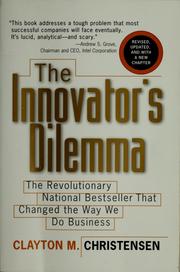
This summer I took time to re-read an oft-overlooked volume that I believe to be the essential to anyone working in marketing and innovation. In this review, I’ll provide a few examples of why this book needs more attention, particularly here in Canada where we definitely need to up our game in marketing of innovation and technology.
Clayton Christensen, as Associate Professor of Business Administration at Harvard Business School, is a leading academic researcher on innovation. Yet, he still manages to provide practical and pragmatic strategies that real companies can use. And, most importantly, his theoretical groundwork is based on extensive, data intensive research over longer period of time with real companies and markets going through disruptive innovation.
The latter term is often thrown around lightly in technology company circles. A Disruptive technology (or innovation) typically has worse product performance in mainstream markets while having key features that interest fringe and merging markets. By contrast, sustaining technologies provide improved product performance (and often price) in mainstream markets.
The book covers real markets, including the various generations of disk drives starting with 14″ drives in the 1970’s to today’s 2.5″ (and smaller) drives. By studying hundreds of companies that emerged, thrived and failed over a 25 year period, some clear patterns emerge. Further examples across a broad range of markets, include he microprocessor market, the transition from cable diggers to hydraulic “backhoes”, accounting software and even the transition of industrial motor controllers from mechanical to electronic programmable models.
The key message of the book is that the playbook for normal (“sustaining”) technology innovation must be thrown away for disruptive technologies. Disruptive technologies break traditional rules in many, often counter-intuitive ways:
Financial – typically disruptive technologies are more expensive and have lower performance than existing products. This effect causes financial managers to kill many such innovations.
Marketing: the normal rule to “listen to your customers” must be thrown away – instead many educated guesses with repeated failures are the only path forward.
Organization: given the ability of normal strategies to reject disruptive innovations, such practices as heavyweight teams (which silo the team with more autonomy) and even spin-outs are the order of the day.
Entrepreneurial writings, not to mention my own experience, encourage us to celebrate failure. Beyond the power of learning by trial and error, The Innovator’s Dilemma, for the first time, provides an analytical framework as to why such failure is so critical in new markets.
One area where the book could provide more guidance is that of differentiating disruptive from sustaining technologies. Such discrimination is absolutely critical to ensure the right strategic approach to the new technology is adopted. Generally easy with the benefit of hindsight, such determination can be very tricky, and error prone, when first confronted with such new technologies.
This is a book that anyone working with products in fast moving markets needs to re-read regularly. It surprises me that, 15 years after publication, how few product marketers and senior executives appear to have benefited from the deep wisdom Christensen imparts.
Building larger technology companies is critical for our future economic well being, yet somehow we seem to pay more attention to the seed and startup phase. This post and a subsequent missive, Wisdom from Recent Waterloo Technology Acquisitions, aim to analyze some recipes for building technology businesses to scale first from the perspective of recent companies and then specifically through the lens of local acquisitions. This pair of posts will be based on extensive data, but the findings are intended to start discussion rather than be the last word.
The importance of building new, innovative, and large, companies can’t be underestimated regionally, provincially and nationally. Here in Waterloo, with perhaps 10 000 jobs at a single behemoth, Research in Motion, the notion of job creation is particularly topical simply to lessen our dependency on such a large company.
My sense is that, of late, most of the focus centres around making startups: small, energetic and entrepreneurial software, web and mobile companies, some simply building a mobile application. And, even with the current notion of Lean Startups or our Venture 2.0approach, there is no question that building such early stage companies is probably an order of magnitude cheaper than it was back in the 1990’s While undoubtedly a good thing for all concerned – founders, investors and consumers all have so much more choice – has this led to a corresponding increase in new major businesses in the technology sector?
I see this as more of a discussion than a simple answer, and thus to start, I include the following table of my sense of how the numbers have changed over time. The following table provides some idea of how company formation has trended over the last 25 years, through the lens of scale rather than acquisitions:
[table “” not found /]
NOTES ON DATA:
Sources: public records, internet, personal recollections and interviews with 20 key ecosystem participants.
The definition of “big” is purposely somewhat arbitrary (and perhaps vague). I am using a threshold of 50 employees or $10 million in revenues, which is probably more indicative of these startups becoming mid-sized businesses.
INITIAL INSIGHTS:
This data, while helpful, can never provide a complete answer. However, it can guide the conversation around what I see to be an important economic mission for our region and country – that is, building more significant technology businesses. I’m sure there are no easy answers, but in shaping policy, it is important to base decisions on informed debate and research.
To that end, I would offer the following thoughts:
The current plethora of “lean startups” does not (necessarily) represent a clear path to growing those startups into larger businesses.
I suspect that, in some ways, multiplying small startups can retard the growth of larger companies. That said, the data are insufficient to prove cause and effect.
At the ecosystem level, we need to focus resource allocation beyond simple startup creation to include building more long term, and larger, technology businesses. Instead of spreading talent and other resources thinly, key gaps in senior management talent (especially marketing) and access to capital (B rounds and beyond) need to be resolved.
Even in day to day discussion, the narrative must shift so that entrepreneurism isn’t just about startups, to make company building cool again.
Canada holds many smart, creative and hardworking entrepreneurs who will undoubtedly rise to the challenge of building our next generation economy. Meanwhile, I’d welcome comments, suggestions and feedback on how we can build dozens or more, instead of a handful, of larger technology companies in our region.
Today was a banner day for announcements involving a reset of the technology funding ecosystem in Canada.
For a long time, the slow demise of Canadian Venture Capital has concerned me deeply, putting us at an international disadvantage in regards to funding and building our next generation of innovative businesses. You may recall my 2009 post Who Killed Canadian Venture Capital? A Peculiarly Canadian Implosion? which recounts the extinction of almost all of the A round investors working in Ontario.
Since then, many of us have worked to bridge the gap by building Angel Networks, including Golden Triangle AngelNet (GTAN), where I chair the Selection process and using extreme syndication and leverage to replace a portion of the missing A rounds.
Today, the launch of Round 13 Capital revealed a new model for venture finance centred around a strong Founder Board whose members are also LPs, each with a “meaningful” investment in the fund. My decision to get involved was based both on this strongly aligned wealth of operating wisdom coupled with the clear strength of the core team.
The launch was widely covered by a range of tech savvy media, including:
To illustrate the both the differentiation of Round 13 and show the depth of founder experience, Bruce Croxon, indicated that the founders board has, measured by aggregate exit value, built over $2.5 billion of wealth in Canada. It is this kind of vision and operational experience that directly addresses the second of my three points that Canadian Venture Capital needs to solve.
It is exciting to be involved with the unfolding next generation funding ecosystem for technology companies of the future. Time will tell the ultimate outcome, but I’m certainly bullish on Round 13.
It is notable that much of the recent trend towards Social Innovation has come from people who began their careers in technology startups, in Silicon Valley or other technology clusters. Some notable examples include:
Bill Gates, partly at the instigation of Warren Buffet who added his personal fortune to that of Gates, left Microsoft, the company he built, to dedicate his life to innovative solutions to large world issues such as global health and world literacy through the Bill and Melinda Gates Foundation
Started by Paul Brainerd, Seattle-based Social Venture Partners International is innovating at the intersection of technology and venture capital, with Venture Philanthropy. Paul sold Aldus Corporation (an innovator in desktop publishing applications, including Pagemaker) to Adobe in the mid 1990s. In his mid-40’s at the time of the Adobe acquisition, he was young enough to seek a significant and active social purpose in his life.
Waterloo’s own Mike Lazaridis aims to transform our understanding of the universe itself by investing hundreds of millions of dollars into Perimeter Institute for Theoretical Physicsn and Institute for Quantum Computing, effectively innovating a new mechanism of education and discovery. Notable is that this area of investment is one that may well take years, possibly decades, to show what breakthroughs, if any, are discovered.
Whether or not always attributtable to this connection with technology entrepreneurs, increasingly Social Sector organizations are starting to become much more like the entrepreneurial startups so familiar in the world of high technology. I’ve personally witnessed some of this change, and would like to suggest, that while there remain big differences, the parallels are strengthening over time. The following concepts represent just a small sampling of the key areas of similarity:
1. Founders Versus Artists
Stories are legion of smart, brash (and even mercurial) technology company founders who transform a business sector through the sheer strength of their wills. Many of these founders are “control freaks” and might find employment in conventional jobs a difficult proposition. Venture capital and angel investors have learned to be wary of such founders, citing numerous examples of founderitis – in which uncoachable founders, in a case of “my way or the highway” would rather maintain control than bend to ideas from often more experienced mentors, board members and investors.
Such personalities also exist in the Social Sector. For example, many arts organizations are founded by bright and innovative artistic directors. And yet, many of these same organizations come unravelled by the same mercurial nature that prevents the organization from being properly governed and accountable to funders (investors). With my background on both sides of this divide, the parallels are hauntingly striking.
Since such founders strengths can also be their undoing (or that of their organization), a conscious Board level assessment of such situations is always wise.
2. Running on Empty
Notwithstanding the media coverage of a few lucky technology startups such as Facebook orGoogle, most technology startups run of little or no significant funding. Many seek to change the world with very small amounts of capital, sometimes no more than several million dollars. The recent trend towards building such small capitalization organizations is called the Lean Startup movement. The challenges inherent in their undercapitalization is often the top complaint of such startups. However, Sergy Brin, the Google co-founder has insightfully observed that “constraints breed creativity” to describe how an underfunded state has led to the discovery of innovative ways to build companies and deliver their products.
Likewise, from my experience the vast majority of charities and nonprofits complain about being undercapitalized, and the reality is that most are. It is a fact of life in the social sector. Only now are we starting to see the emergence of social ventures, which by stealing a page from underfunded technology startups are exploring new business models and ways to deliver social change, often leveraging IT or a different process to vastly reduce costs of program delivery.
3. Technology Changes Everything
We’ve seen the emergence of a world where all information is stored in digital form and people are connected, even while mobile, the role of the web and technology can’t be underestimated. Technology-based startups, because they are small and start from scratch, often approach traditional problems in very non-traditional ways. Revenue and funding models change, as do fundamental ways to organize a business or social enterprise. Social media allows ideas to spread in a viral fashion. We have already seen how organizations like Avaaz can mobilize hundreds of thousands or even millions of supporters globally for both local and international issues of social injustices and poverty. This is a direct analogue to how many people now rely on Twitter or Facebook, rather than a printed newspaper, for much of their news and information.
4. Mission Creep – or the path forward
Technology startups have come to learn that success depends on laser sharp focus, attention to detail and execution of a “pure play” strategy (ie. only do one thing well). Thatparticular discipline has time and time again proven to be effective in a sector where technology change is moving rapidly and most startups are generally considered to be underfunded.
Likewise, Social Enterprisesmust adopt similar approaches to deal with underfunding and change. Even in today’s more fluid and fast-changing environment, to avoid deadly Mission Creep, Board and management must have developed a complete Theory of Change roadmap to enable Manage to Outcomes.
First of all, I would like to congratulate Phil Deck, Michael Harris and the entire team for finding both a fabulous new home for MKS, but also one which represents a significant strategic financial transaction, valuing MKS at just over 4 times estimated FY2011 sales.
Many people have asked for my perspective. In short, I continue to view the acquisition as favourable to customers, employees, Waterloo and its shareholders. To delve further, this article, written from my own perspective, gives both background and some lasting observations and universal lessons from MKS.
Over the last decade, MKS largely sat out the wave of consolidations in Applications Lifecycle Management (ALM, that builds on the earlier category of Software Configuration Management), for example:
IBM acquiring Rational Software for $2.1 billion on 6 December, 2002,
Mercury Interactive acquiring Kintana for $225 million on 10 December, 2003,
Serena Software acquiring Merant on 3 March, 2004 for $380 million, followed by
Silver Lake Partners, a private equity firm, acquiring Serena Software for $1.2 billion on 11 November, 2005,
IBM acquiring Telelogic (which had earlier bought MKS competitor Continuus Software) for $745 million during April 2008
The aforementioned almost $5 billion acquisition binge represented a huge shift in the ALM market dynamics. By 2011, a new driver for acquisitions had emerged. As engineered products start to contain more software value than traditional hardware, customers requirements in the Product Lifecycle Management space started to converge with the Application Lifecycle Management space. This blending and merging of categories, fuelled by the trend to software being the dominant product differentiator, led to the acquisition of MKS by PTC and may portend more activity as these spaces continue to consolidate. Because PTC is moving into a new, but adjacent market category, that means that the domain expertise from the MKS product teams will be critical to PTC‘s long term success.
Could MKS have remained independent? My sense is, in the longer term, no. In the 1990s, a company could IPO on the NASDAQ at around $20 million revenues. Today, that number is over $100 million, and MKS at acquisition had about $75 million revenues. Perhaps further acquisitions might have accelerated getting to scale, but without a NASDAQ public currency that would have been difficult. Therefore, that’s a key reason why the PTC acquisition is such a home run win for MKS.
MKS built great value as a significant global software business over its 27 years of pre-acquisition existence. I’m very pleased that, unlike some early stage start up acquisitions, this likely means that PTC will continue to see Waterloo as a base for further expansion based around the solid product R&D team. In that sense, it’s great news for the region’s economy and something I’m very happy to see.
I wanted to reflect on a few themes that I’ve seen play out over MKS‘ long history – both lessons learned and some principles that might help some of the current crop of start ups grow into global businesses headquartered in Waterloo.
PIVOTS
MKS definitely was a company that had the proverbial “9 lives”. Using the au courant start up lingo, these were critical “pivots”. The number of pivots arises partly because MKS was a multi-product company and even more so because MKS was a first generation of software company in Canada, before clear rules to build such a knowledge based business had been formulated. Achieving company growth means many battles fought (and not all successfully) to win the war of business success. I’ve also come to learn that timing can trump even the most gifted product strategy work or execution attempts. As a result, ultimate success can be seasoned by many failures along the way to that success.
The following summarizes some of those 9 lives inside MKS:
The original name of MKS Inc. was MorticeKern Systems Inc. – not taken, as often supposed from an aging and curmudgeonly New York accountant, but rather inspired by two typesetting terms that connote a sort of Zen in the ancient arta of hot lead typesetting. The pre-incorporation business plan for MKS to be the first to develop and commercialize the then state of the art, full page desktop publishing. When the US technique seeking venture capital to fund this exposed that venture capital hadn’t yet begun in Canada, the company moved on to a bootstrap mode (which is oddly similar to the state of many startups and financing today).
As mentioned, to have the resources to develop products, we put out a shingle to do contract development work for such major companies as Imperial Oil, Westinghouse, Ontario Ministry of Education and Commodore. Using a portion of the millions of revenues this generated, and with learnings from development and cross-development on the naked IBM PC and MS-DOS, we started to create our first product.
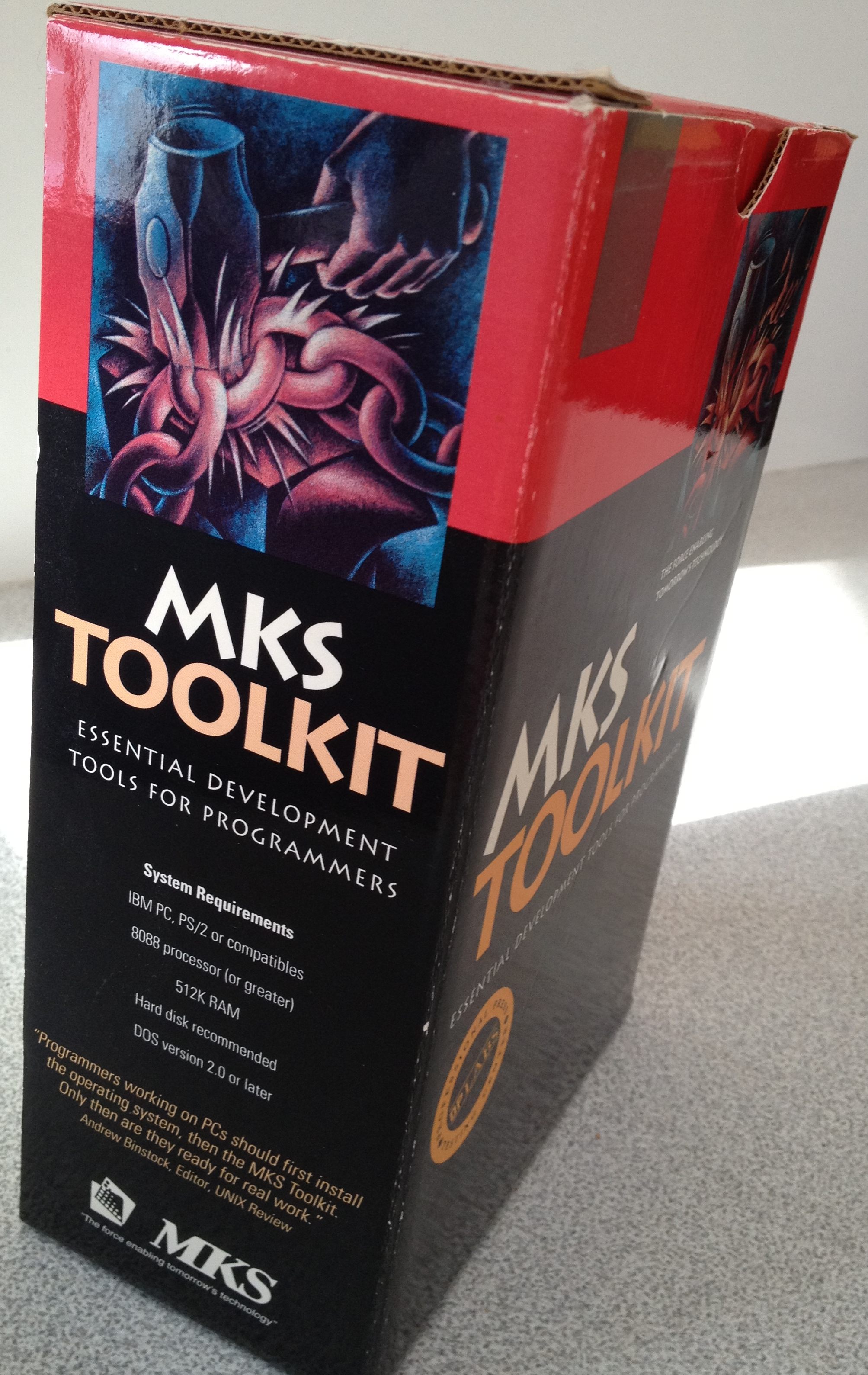
MKS Toolkit was, as mentioned, directly inspired by a gap in the market, and by 1985 was shipping its first products. MKS Toolkit thrives, in morphed form, to this day, and more important has spawned many of the later product directions over the next 25 years.
InterOpen emerged from my recognition that POSIX (and later x/OPEN) was being cast as Federal Information Processing Standards (FIPS, from National Institute of Standards and Technology) that meant that all existing, non-UNIX systems (we called them proprietary back then) must adopt POSIX compliant interfaces and tools. InterOpen ultimately, over many years, generated $50 million or more of OEM licensing revenues for MKS. InterOpen technology instrumental in IBM Open Edition MVS, HP MPE/ix, DEC VAX/VMS, Fujitsu SureSystem and many others.
By 1988, we had taken an add-0n to MKS Toolkit, and named it MKS RCS which was the first generation software management system product, built around revision (version) control for software development projects.
In 1992, another tool arising from MKS Toolkit (uucp), along with an innovation proposal from Dale Gass, led to the creation of MKS Internet Anywhere. Prior to Windows 95, with no TCP/IP stack or internet functionality, this was a consumer-grade suite bundling everything from browser, FTP, email client with the necessary stack for the market. With the battle by Microsoft to kill Netscape still in the future, this division along with a dozen including some of our most talented staff, was sold off to Open Text Corporation in 1994.
By 1993, MKS had re-built from scratch the original MKS RCS into its first enterprise-grade product – a suite now branded as MKS Source Integrity. From then on, this was the highest growth key focus for the company, although it took some time to be profitable, being cross-subsidized by the high margin successes of MKS Toolkit and InterOpen.
By 1995, another key MKS employee, David Rowley, drove the creation of MKS Web Integrity, which I believe to be the first ever enterprise web content management system. Although licensed into the Netscape SuiteSpot Server, along withInformixdatablades and Verity search technology, perhaps the focus (and Venture Capital financing) of a pure play strategy might have given it more ammunition against early competitors like Interwoven and Vignette.
Eventually, the need to clearly position the enterprise software management products as the sole focus of the company, and to distance from some confusion with the tools and developer-based MKS Toolkit product line, an attempt was made to separate and brand as Vertical Sky. Whether or not this might have worked at a different time, the Dot Com meltdown of 2000 meant that it was impossible to raise investment to finance such a roll out. Ultimately, Phil Deck and the new management did continue the separation and promotion of MKS Source Integrity to full enterprise grade, but without the added costs of the Vertical Sky rebranding.
Although there were many more than the above sample 9 lives, I think that the twists and turns to build a real business are a critical lesson for today’s companies. At Verdexus we today ascribe to the pure play strategy for startups (less capital required, more focus and easier to explain to investors). Nonetheless, there is much to be said for building a strong base around multiple product innovation.
WORLD CLASS TEAM
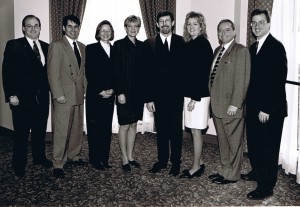
While the players have changed over the years, MKS has been blessed by an amazing group of employees, and not just in senior management. For example, at the time of our proposed NASDAQ IPO in early 1997, the investment bankers from Hambrecht & Quist in San Francisco mentioned, upon meeting our senior team, that this was amongst the strongest they have ever seen. Part of this came from hiring both from US and Canada (See GLOBAL APPROACH below) and that includes non-Canadian executives such as Tobi Moriarty, Mike Day, Holger Schmeidefeldt and Frank Schröder. We really did take to heart the maxim that great leadership came from a strong team, as I discussed in “The Power of Two (Or Three)“.
A positive environment led to better gender balance and better results. For example, in 1996 the senior management team of 7, included 3 women. Such a balance, sadly rare even today, led to enhanced results and sense of opportunity across the entire staff.
(l->r) Ralph Deiterding, Eric Palmer, Ruth Songhurst, [TSX VP], Randall Howard, Tobi Moriarty, Mike Day, David Rowley
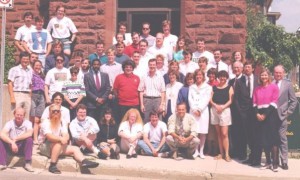
I am most pleased by the many talented employees at MKS, from co-op students onwards, who have gone on to incredible heights of achievement. I am continually discovering another company that has been built by talent that got its first state of the software business at MKS. I think one approach that has real merit, was the notion to bring top global talent into the business, in part for the mentoring effect this has on other employees. Considering the Waterloo ecosystem in the 1990s, this was particularly helpful in building previously thin functional areas such as marketing and product management.
MKS Team (circa 1992) – Old Post Office, Waterloo
Finally, given recent media attention to weak and/or non-independent boards, I was pleased to have a board that was both global and always able to hold management accountable. As CEO, I can remember many uncomfortable moments when I, or other management team members, were seriously challenged, and that is exactly how it should be.
GLOBAL APPROACH
Perhaps because I had my first software start up experience in the US (building Coherent), it only seemed natural to focus on the entire North American market, and ignore conventional advice to start with the local region, province or country. Even in the very earliest days of MKS Toolkit, when products were shipped by mail and advertised in physical magazines, we realized that every promotional dollar went much farther in the US versus just focusing on Canada. The led to perhaps the first customer of MKS Toolkit being AT&T Bell Labs, which I believe contributed to MKS becoming known across North America in developer circles. The use of 800 toll free numbers across US and Canada, coupled with email, allowed us to work and act like a US company. To me, it always felt similar to the Israeli model for tech companies.
By the 1990s, although we had distributors in Europe (and a small few in Asia), we decided invest heavily in the European market, first from a beachhead in Germany and then the UK. By 2000, Europe represented about 35% of the company’s revenues which later proved a strong hedge to the US-centric meltdown that started in 2000.
CAPITAL
Although MKS pre-dated Canadian venture capital, it did access the capital markets through various vehicles, such as the Special Warrant and IPO, that were common in the 1990s. During my tenure, about $40 million was raised, and I believe that the whole lifecycle raise was in excess of $50 million. During the 1990s, this was the normal cost to build a major entrprise software company to full scale. Today, while our Venture 2.0 methodology and the Lean Startup approach lessens the capital requirements, I still believe that, over the longer term, building a significant business takes much more capital than people realize.
One consequence of this, coupled with the more limited capital available in Canada (at least Ontario), is the tendency of technology companies to exit early – when they are partly built start ups rather than full businesses. In a way, this means that acquiring companies are really only getting a product and development team in a form of outsourced innovation. The downside of this model would seem to me to be the creation and maintenance of far fewer jobs in our region. I would love to see a rigorous study of this effect. In fact, my next post will explore the stage and timing of significant Waterloo region technology company acquisitions.
GROWTH BY ACQUISITIONS
Although MKS never had the NASDAQ public currency, being public on the TSX enabled the 7 acquisitions I was involved in. I would say that acquiring companies was a real learning curve. On balance, we managed to increase our acquisition capabilities over time, but always the results took longer than expected. For example, the acquisition of the AS/400 business from Silvon brought MKS many of today’s largest customers (e.g. HSBC), but the anticipated synergies took 2-3 years or more rather than the predicted 18 months to materialize.
The bigger issue, beyond building M&A expertise, is that today it is harder for companies to go public and have market liquidity for acquisitions than in the 1990s. I’m not sure if 21st century capital markets will ever return to a state where that is again possible.
FUN AND CAMARADERIE
Last, but definitely not least, most days whether travelling to engage the world or back in the office, people had a lot of fun while building a great business. The right mix of “work hard, play hard” can lead to a better overall experience that, in so many ways, enhances overall performance. And, we had some pretty great parties, whether at product launches in California or Europe or simply back home celebrating key milestones for MKS.
SUMMARY
The above observations represent but a small taste of my thoughts regarding the recent MKS acquisition. My hope is that the Waterloo tech ecosystem will witness many more companies being able to transcend the start up phase to become globally leading businesses. The future of our country and region depends on it.
NOTE: The intrusion and profusion of projects in my life, has prevented blogging for some time. As 2011 draws to a close, I thought I needed to make an effort to provide my perspective on some important milestones in my world.
I just heard that, after a long illness, Dennis Ritchie (dmr) died at home this weekend. I have no more information.
I trust there are people here who will appreciate the reach of his contributions and mourn his passing appropriately.
He was a quiet and mostly private man, but he was also my friend, colleague, and collaborator, and the world has lost a truly great mind.
Although the work of Dennis Ritchie has not been top of my mind for a number of years, Rob’s posting dredged up some pretty vivid early career memories.
As the co-creator of UNIX, along with his collaborator Ken Thompson, as well as the C Programming Language, Dennis had a huge and defining impact on my career, not to mention the entire computer industry. In short, after years as a leader in technology yet market laggard, it looks like in the end, UNIX won. Further, I was blessed with meeting Dennis on numerous occasions and, to that end, some historical narrative is in order.
Back in 1973, I got my first taste of UNIX at the University of Waterloo, serendipitously placing us among a select few who tasted UNIX, outside of Bell Labs, at such an early date. How did this come about? In 1972, Steve Johnson spent a sabbatical at University of Waterloo and brought B Programming Language (successor to BCPL and precursor to C, with all its getchar and putchar idiom) and yacc to the Honeywell 6050 running GCOS that the University’s Math Faculty Computing Facility (MFCF) had installed in the summer of 1972. Incidentally, although my first computer experience was in 1968 using APL on IBM 2741 terminals connected to an IBM 360/50 mainframe, I really cut my “hacker” teeth on “the ‘Bun” by writing many utilities (some in GMAP assembler and a few in B). But, I digress . .
Because of the many connections made by Steve Johnson at that seminal time, University of Waterloo was able to get Version 5 UNIX in 1973 before any real licensing by Western Electric and their descendents by simply asking Ken Thompson to personally make a copy on 9 track magnetic tape. My early work at Computer Communications Networks Group (CCNG) with Dr Ernie Chang attempting to build the first distributed medical database (shades of Personal Health Records and eHealth Ontario?) led me to be among the first to get access to the first Waterloo-based UNIX system.
The experience was an epiphany for me. Many things stood out at the time about how UNIX differed from Operating Systems of the day:
Compactness: As described by a fellow UNIX enthusiast at the time, Charles Forsyth, it was amazing that the entire operating system was barely 2 inches thick. This compared tot he feet of listings for GCOS or OS/360 made it a wonder of minimalistic compact elegance.
High Level Languages: The fact that almost 98% of UNIX was coded in C with very little assembler, even back in the days of relatively primitive computing power, was a major breakthrough.
Mathematical Elegance: With clear inspiration from nearby Princeton and mathematical principles, the team built software that for the day was surprisingly mathematically pure. The notion of a single “flat file” format containing only text, coupled with the powerful notion of connecting programmes via pipes made the modular shell and utility design a real joy to behold.
Extensible: Although criticized at the time for being disc- and compute-intensive and unable to do anything “real time”, UNIX proved to have longevity because of a simple, elegant and extensible design. Compare the mid-1970’s UNIX implementations supporting 16 simultaneous users, on the 16-bit DEC PDP-11/45 with 512KB (note that this is “KB” not “MB”) with today’s Windows quad-core processors that still lock out typing for users, as if prioritized schedulers had never been invented.
At Waterloo, I led a team of UNIX hackers who took over an underused PDP-11/45 and create Math/UNIX. On that system, many top computer talents of today adopted it as their own, including Dave Conroy, Charles Forsyth, Johann George, Dave Martindale, Ciaran O’Donnell, Bill Pase and many more. We developed such innovations as highly personalized security known as Access Control Lists, Named Pipes, file and printing networked connections to Honeywell 6050 and IBM mainframes and much more. Over time, the purity of UNIX Version 7 morphed into the more complex (and perhaps somewhat less elegant, as we unabashedly thought at the time) Berkeley Systems Distribution (BSD) from University of California at Berkeley. That being said, BSD added all-important networking capabilities using the then nascent TCP/IP stack, preparing UNIX to be a central force in powering the internet and web. As well, BSD added many security and usability features. My first meeting with Dennis Ritchie was in the late 1970’s when he came to speak at the U of W Mathematics Faculty Computer Science Club. Having the nicest car at the time, meant that I got to drive him around. I was pleasantly surprised at how accessible he was to a bunch of (mostly grad) students. In fact, he was a real gentleman. We all went out to a local pub in Heidelberg for the typical German fare of schnitzel, pigtails, beer and shuffleboard. I recall him really enjoying a simple time out with a bunch of passionate computer hackers. I, along with Dave Conroy and Johann George, moved on from University of Waterloo to my first software start up, Mark Williams Company, in Chicago, where I wrote the operating system and many utilities for the UNIX work alike known as Coherent. Mark Williams Company, under the visionary leadership of Robert Swartz, over the years hosted some of the top computer science talen in the world. Having previously worked with Dave Conroy on a never completed operating system (called Vesta), again the intellectual purity and elegance of UNIX beckoned to me to build Coherent as a respectful tribute to the masters at Bell Labs. Other notable luminaries who worked on Coherent are Tom Duff,Ciaran O’Donnell, Robert Welland, Roger Critchlow, Dave Levine, Norm Bartek and many more. Coherent was initially developed on the PDP-11/45 for expediency and was running in just over 10 months from inception. A great architecture and thoughtful design, meant that it was quickly ported to the Intel x86 (including the IBM PC, running multi-user on its non-segmented, maximum of 256KB of memory), Motorola 68000 and Zilog Z8001/2. The last architecture enabled Coherent to power the Commodore 900 which was for a time a hit in Europe and, in fact, used by Linus Torvolds as porting platform used in developing Linux. I got to meet Dennis several times in the context of work at Coherent. First, in January 1981 at the then fledgling UNIFORUM in San Francisco, Dennis and several others from Bell Labs came to the Mark Williams suite to talk to us and hear more about Coherent. I remember Dennis reading the interrupt handler, a particularly delicate piece of assembler code and commenting about how few instructions it took to get through the handler into the OS. Obviously, I was very pleased to hear that, as minimizing such critical sections of the code is what enhanced real time response. The second time was one of my first real lessons in the value of intellectual property. Mark Williams had taken significant measures to ensure that Coherent was a completely new creation and free of Bell Labs code. For example, Dave Conroy‘s DECUS C compiler, written totally in assembler, was used to create the Coherent C compiler (later Let’s C). Also, no UNIX source code was ever consulted or present. I recall Dennis visiting as the somewhat reluctant police inspector working with the Western Electric lawyers, under Al Arms. Essentially, he tried all sorts of documents features (like “date -u” which we subsequently implemented) and found them to be missing. After a very short time, Dennis was convinced that this was an independent creation, but I suspect that his lawyer sidekick was hoping he’d keeping trying to find evidence of copying. Ironically, almost 25 years later, in the SCO v. IBM lawsuit over the ownership of UNIX, Dennis’s visit to Mark Williams to investigate Coherent was cited as evidence that UNIX clone systems could be built. Dennis’s later posting about this meeting is covered in Groklaw. In 1984, I co-founded MKS with Alex White, Trevor Thompson, Steve Izma and later Ruth Songhurst. Although the company was supposed to build incremental desktop publishing tools, our early consulting led us into providing UNIX like tools for the fledgling IBM PC DOS operating environment (this is a charitable description of the system at the time). This led to MKS Toolkit, InterOpen and other products aimed at taking the UNIX zeitgeist mainstream. With first commercial release in 1985, this product line eventually spread to millions of users, and even continues today, surprising even me with both its longevity and reach. MKS, having endorsed POSIX and x/OPEN standards, became an open systems supplier to IBM MVS, HP MPE, Fujitsu Sure Systems, DEC VAX/VMS, Informix and SUN Microsystems.During my later years at MKS, as the CEO, I was mainly business focussed and, hence, I tried to hide my “inner geek”. More recently, coincidentally as geekdom has progressed to a cooler and more important sense of ubiquity, I’ve “outed” my latent geek credentials. Perhaps it was because of this, that I rarely thought about UNIX and the influence that talented Bell Labs team, including Dennis Ritchie, had on my life and career. Now in the second decade of the 21st century, the world of computing has moved on to mobile, cloud, Web 2.0 and Enterprise 2.0. In the 1980’s, after repeated missed expectations that this would (at last) be the “Year of UNIX” we all became resigned to the total dominance of Windows. It was, in my view, a fatally flawed platform with poor architecture, performance and security, yet Windows seemed to meet the needs of the market at the time. After decades of suffering through the “three finger salute” (Ctrl-ALT-DEL) and waiting endlessly for that hourglass (now a spinning circle – such is progress), in the irony of ironies UNIX appears on course to win the battle for market dominance. With all its variants (including Linux,BSD and QNX),UNIX now powers most of the important Mobile and other platforms such as MacOS, Android, iOS (iPhone, iPad, iPod) and even BlackberryPlaybook and BB10. Behind the scenes, UNIX largely forms the architecture and infrastructure of the modern web,cloud computing and also all of Google. I’m sure, in his modest and unassuming way, Dennis would be pleased to witness such an outcome to his pioneering work.
The Dennis Ritchie I experienced was a brilliant, yet refreshingly humble and grounded man. I know his passing will be a real loss to his family and close friends. The world needs more self-effacing superstars like him. He will be greatly missed.
I think there is no more fitting way to close this somewhat lengthy blogger’s ramble down memory lane than with a humorous YouTube pæan to Dennis Ritchie Write in C.
This week I had the pleasure to be the luncheon speaker during the Ignite Entrepreneurship course put on by Guelph Partnership for Innovation, aimed at University of Guelph graduate students from various technical fields including biology, life sciences, materials, agribusiness, etc.
It’s always a thrill to get into a room with 40 or so energetic and bright grad students who are considering going into business. And, kudos to GPI for hosting this.
As an experiment, I broadcast the 3 questions out into social media-verse (Facebook, LinkedIn, Twitter) and got some great UGC that I factored into the presentation.
Here are the questions regarding Money and Startups that I attempted to address:
Do you really need it?
Where will it come from? and
What will you do with it?
I’d be delighted if any of you could comment on the topic as well. It’s an extraordinarily challenging time to startups to find funding right now, and the importance of a healthy pipeline of new companies to our future well being, has led me to dedicate a fair portfion of my social enterprise/sharing time to the issue of the serious funding gap for startups.
Note that while much of this is of global relevance, part of the advice is very specific to the startup funding landscape in Ontario.
“Fortes fortuna adiuvat” – “Fortune favours the bold” – Latin proverb
The current economic meltdown has unleashed brutal forces acting on all aspects of the business world, but certainly innovative startups in fields like software, web, wireless, green technologies and life sciences are at grave risk. In Canada, our startups have generally been world class innovators, but severely underfunded when benchmarked against US and leading European countries.
Not only has the credit crunch forced most Angel Investors to the sidelines, but the supply of Venture Capital (VC) in Canada has contracted almost to the vanishing point.
Having started my first software company in the mid-1980’s, I am well aware that although VC money was available and well established in the Silicon Valley, VC money for knowledge-based startups such as mine was then nonexistent in Canada. Through the 1990’s, however, Canada started to build a cadre of new funds that showed early promise of replicating a US style VC funding ecosystem
In the early millennium when Verdexus investigated raising a institutional fund to fill a gap in the Canadian market with our “hands on” model and accessing global capital sources. It gave our partners a chance to look to VC best practices on a global basis and figure out how to apply to the Canadian context. While we didn’t proceed at that time, I’ve had the good fortune to work on projects with top VCs from the US and several European countries, giving me a global perspective on how Canadian Venture Capital measures up.
Sadly, I believe that the 2000/2001 tech bubble, or dot com meltdown, stopped the maturation of our VC industry in its tracks, a body blow from which the industry has never recovered. It is to this time that the root causes of our current VC meltdown can be traced. A few of the main reasons holding the VC industry back can be summarized as follows:
Impact of the Labour Sponsored Investment Fund model on our VC ecosystem.
Lack of balance between financial and operational skills: The Banker Effect.
Lack of International Funding discipline in our VC industry.
I will explore each of these causes in turn.
1. Labour Sponsored Investment Funds
Labour Sponsored Investment Funds (LSIFs, also known as Retail Venture Capital Funds), have been a particular sore spot, as a 2005 Globe and MailReport on Business article “Labour-sponsored Love Lost” points out. Considered good public policy when launched in the late 1980’s, both Federal and Provincial governments gave individual (retail) investors a significant tax incentive (up to 35%) to invest up to $5 000 with a minimum 8 year hold period. In essence, many funds totalling hundreds of millions of dollars were raised by firms like VenGrowth, Covington and Growthworks as were numerous very small funds.
Lacking the inherent financial discipline imposed by typical venture capital structures, in which several “funds of funds” (legally dsignated as Limited Partners, or LPs) invest in a fund managed by a General Partner (or GP). The LPs in this sense have much leverage, not just in choosing their GPs, but also in ongoing oversight, not to mention the choice to re-invest in the next fund raised by the GPs. This LP/GP structure is the model employed world wide and has generally stood the test of time.
The thousands and thousands of retail investors in a typical LSIF exert no such control and hence we’ve seen Management Expense Ratios (MERs) as high as 4-6% versus the 2% private equity industry norm and Carried Interest (the portion of the investment gains shared by the fund) as high as 30% versus the 20% norm.
More importantly, although at its peak, more than half of Canadian VC money was in LSIF funds, returns were, as Doug Steiner says, “lousy.” How lousy? Studies show that average fund returns, also called Internal Rate of Return (IRR), are negative. The best fund appears to have produced a measly 1% IRR. In the US, funds aim for 30% and there is a long term track record of many funds in the 18-20% range.
Undoubtedly, individual investors didn’t have a lot at stake with those huge tax credits and it can be argued that LSIFs encouraged loads of job creation in the all important knowledge economy. All of that is true. My main concern is that the attraction of the LSIF model impaired the formation of a more mature VC ecosystem based on the normal LP/GP model mentioned above.
2. The Banker Effect
Credit: AIAlex.com
In the US, both in California’s Silicon Valley and in the Route 128 area around Boston, the VC industry has always been populated by a healthy mix of the financially oriented fund managers coupled with serial entrepreneurs who have founded and build technology startups. The composition of the partners at Canadian VC funds has always been different than this international norm, having many more banker types than operators. The experiences Jonathan Geist relates in the Canadian Business article are symptomatic of this difference. Too much focus on the numbers is like looking in the rear view mirror when startups need to be focused on the future – building market share, refining partnerships and developing strong go-to-market execution.
Again, I believe that this gap can be attributed to us being a less mature VC and startup ecosystem. In the late 1980’s and 1990’s finding seasoned technology startup operators would have been almost impossible. Most were still building their first startup. However, had things unfolded as they should have, many of the startup founders from the 1980’s and 1990’s should now be partners at Canadian VC firms. That didn’t happen because the dot com meltdown appeared to remove the ability to the industry to make changes or take risks. Ironically, this exacerbated an already more conservative VC culture here in Canada, and this more risk averse approach actually contributed to the lower IRRs seen when Canadian VCs are compared to their US or European peers.
3. Lack of International Money
The fledgling LP/GP VC industry of the 1990’s was funded by a relatively small ecosystem of LPs, such as OMERs, Caisse de Depot, Teachers, CPP, BDC, etc. Thus every VC fund was essentially not differentiated by its LP composition. In essence, a closed group of Canadian fund of funds all were chasing this same relatively small asset class. Furthermore, the relaxation of Canadian content rules coupled with these aforementioned low IRRs, sent the Canadian LPs looking elsewhere (mostly abroad).
What is the right recipe to change this situation? Quite simply, access to more global sources of money. The thousands of US, European and Gulf institutional fund of funds investors have largely ignored investments in Canadian VC funds. This is partially because of the chicken and egg of lower IRR returns. But, more fundamentally, it is primarily because the Canadian startup and VC ecosystem had low visibility to these international funds. Several years ago, I spoke to a large €6 billion LP fund at EVCA in Barcelona, that had investments in 40 tier 1 VC firms in each of the US and Europe. Ironically, that LP’s sense of the Canadian technology scene was limted to Nortel. Since Nortel hasn’t really been a star for many years. Clearly we have a long way to go market our great technology stories to the world.
The Way Forward
Unlike this sign, I don’t want to end this piece on a note of doom and gloom. Nor do I want to leave the impression that there aren’t very talented people in the Canadian VC industry. Nothing could be further from the truth – our long term VC gap arises from long term structural challenges, such as a lack of discipline as imposed by global LPs and not having reached the proper banker/operator mix. There are other factors, including the small population and large geography unique to Canada, but all can be and should be overcome with the proper model.
We already have a few outliers in our funding ecosystem. Being optimistic and entrepreneurial, I’m convinced that many talented individuals will find ways to, little by little, to invent and rebuild a healthy network of startup financing alternatives. As I’ve argued in other blog posts, there is a role for governments. However, that role isn’t to pick winners or to enter the VC business directly, rather it is to be a catalyst to the process by streamlining (securities) regulation and taxation.
As a stakeholder in the success of knowledge-based startups, what do you think?
In today’s challenging economic times, it is extra important for governments, academics and individuals to plan our future economic prosperity. Thus, it is timely that Richard Florida and Roger Martin from the Martin Prosperity Institute, Rotman School of Management, University of Toronto this month published Ontario in the Creative Age, which provides a detailed future-oriented policy blueprint.
It sets a policy agenda to help us unleash our full potential in the Twenty-first Century where economic success is increasingly coming from creatively-oriented enterprise versus our traditional strength in routine physical and routine service occupations. The report is backed by research which highlights both our existing strengths and weaknesses including those in education, income and even the gap in our creative/routine job mix compared to our peers. Starting from the base of today, the agenda suggests four main focus areas to drive future prosperity:
“Harness the creative potential of Ontarians”, including businesses’ role in changing job mix, education and even marketing of our capabilities,
“Broaden our talent base”, focused on significant increases to our post secondary educational levels and broadening managerial capabilities,
“Establish new social safety nets”, including early childhood development, better utilization our key immigrant resource and retraining of older workers from declining occupational groups, and
“Build province-wide geographic advantage” which strengthens connections (physical and otherwise) within and beyond the mega-region spanning Waterloo-Toronto-Ottawa-Hamilton-Niagara-Rochester.
Having read this paper, it is encouraging to see such a forward thinking analysis that will certainly drive future governmental, business and economic decision and policy making. With that in mind, and being of an optimistic “yes we can” mentality, I was, however, struck by how very little attention was paid to the biggest gap of all — Funding this agenda.
Without proper funding, our ability to transform our economy in these wise and necessary ways, will go unfulfilled. I’ve written about this “funding gap” numerous times and from different perspectives:
our recent Federal Budget was chock full of stimulus measures, but seemed totally blind to the creative transformation. For example, I discussed potential green technology initiatives in A Bright Green Federal Budgetary Stimulus Opportunity
I’m certainly not alone in this concern. Many others in positions of thought leadership have raised the issue of funding of investment, some with very specific policy proposals and others just highlighting the gap:
Avvey Peters from Waterloo’s Communitech blogged about Magic Words: Economic Stimulus right before the Canada’s Januaray federal budget, and her post contains some very specific policy measures.
Dr. Ilse Treurnicht, CEO of MaRS Discovery District, a leading Ontario driver of research and commercialization, provided a well-researched analysis of the major institutional and venture funding gaps of Canada compared to other jurisdictions in their latest newsletter.
Alec Saunders, CEO of one of Canada’s most promising web/mobile startups, Iotum, addressed the tech startup funding gap in the context of the proposed federal stimulus in his blog post Tech in Canada: Can We Do More Than Play Hockey? Also, a number of international discussions of technology competitiveness have been hosted on their innovative Calliflower service.
Make no mistake, having surveyed funding sources for startups and social enterprise, Ontario (and Canada) significantly lags most regions in the US and Western Europe — our primary OECD comparables. The reasons for this are numerous and will be discussed in a separate posting, but this funding gap is our extra hurdle before we can be successful in driving the Florida/Martin challenge to transform Ontario to a creative economy.
And to be clear, this transition to the creative economy needs to be driven by the competitive, market economy. That implies that it will not the primary role of governments to provide the major funding for our transformation. Fundamentally, governments should not be picking winners and losers, but simply equiping market forces to go to work. And, given our long history and culture of relying on governments for answers, it is important to clarify that point. With the right framework in place, businesses and individuals will compete to drive the path to our future.
Thus, as their primary task, it is imperative that our federal and provincial governments develop a strong and co-ordinated policy framework, dealing with taxation, security regulation, and the like, to encourage the private sector to make such investments. And, in our current times of economic stimulus, the extra icing on the cake should be to channel some of those near term stimulus dollars toward growing the creative sector that is so essential to our future economic prosperity.



 Bill Gates, partly at the instigation of Warren Buffet who added his personal fortune to that of Gates, left Microsoft, the company he built, to dedicate his life to innovative solutions to large world issues such as global health and world literacy through the
  Started by Paul Brainerd, Seattle-based
  Jeffrey Skoll, a Canadian-born billionaire living in Los Angeles and an early employee of
  Waterloo’s own Mike Lazaridis aims to transform our understanding of the universe itself by investing hundreds of millions of dollars into
 (l->r) Ralph Deiterding, Eric Palmer, Ruth Songhurst, [TSX VP], Randall Howard, Tobi Moriarty, Mike Day, David Rowley
 MKS Team (circa 1992) – Old Post Office, Waterloo

 In 1984, I co-founded MKS with Alex White, Trevor Thompson, Steve Izma and later Ruth Songhurst. Although the company was supposed to build incremental desktop publishing tools, our early consulting led us into providing UNIX like tools for the fledgling IBM PC DOS operating environment (this is a charitable description of the system at the time). This led to MKS Toolkit, InterOpen and other products aimed at taking the UNIX zeitgeist mainstream. With first commercial release in 1985, this product line eventually spread to millions of users, and even continues today, surprising even me with both its longevity and reach. MKS, having endorsed POSIX and x/OPEN standards, became an open systems supplier to IBM MVS, HP MPE, Fujitsu Sure Systems, DEC VAX/VMS, Informix and SUN Microsystems.
 During my later years at MKS, as the CEO, I was mainly business focussed and, hence, I tried to hide my “inner geek”. More recently, coincidentally as geekdom has progressed to a cooler and more important sense of ubiquity, I’ve “outed” my latent geek credentials. Perhaps it was because of this, that I rarely thought about UNIX and the influence that talented Bell Labs team, including Dennis Ritchie, had on my life and career. Now in the second decade of the 21st century, the world of computing has moved on to mobile, cloud, Web 2.0 and Enterprise 2.0. In the 1980’s, after repeated missed expectations that this would (at last) be the “Year of UNIX” we all became resigned to the total dominance of Windows. It was, in my view, a fatally flawed platform with poor architecture, performance and security, yet Windows seemed to meet the needs of the market at the time. After decades of suffering through the “three finger salute” (Ctrl-ALT-DEL) and waiting endlessly for that hourglass (now a spinning circle – such is progress), in the irony of ironies UNIX appears on course to win the battle for market dominance. With all its variants (including Linux, BSD and QNX), UNIX now powers most of the important Mobile and other platforms such as MacOS, Android, iOS (iPhone, iPad, iPod) and even Blackberry Playbook and BB10. Behind the scenes, UNIX largely forms the architecture and infrastructure of the modern web, cloud computing and also all of Google. I’m sure, in his modest and unassuming way, Dennis would be pleased to witness such an outcome to his pioneering work.


 Credit: AIAlex.com
 Unlike this sign, I don’t want to end this piece on a note of doom and gloom. Nor do I want to leave the impression that there aren’t very talented people in the Canadian VC industry. Nothing could be further from the truth – our long term VC gap arises from long term structural challenges, such as a lack of discipline as imposed by global LPs and not having reached the proper banker/operator mix. There are other factors, including the small population and large geography unique to Canada, but all can be and should be overcome with the proper model.
 Avvey Peters from Waterloo’s
  Dr. Ilse Treurnicht, CEO of
  Alec Saunders, CEO of one of Canada’s most promising web/mobile startups,
  Peter Childs, an Ottawa social media strategist and tech luminary, has laid out a framework
29 Oct 2012
0 CommentsTech Terroir
In the world of wine, the concept of terroir describes a centuries long process in which the climate, soil, grape varieties and dedicated vintners, symbiotically develop a unique “sense of place” for a wine region. A favourite of mine, the garrulous and quintessential Californian vintner, Randall Grahm, while trying to establish the old World notion of terroir in California postulates that it is a long term proposition and can take centuries to develop.
As both a wine lover and serial tech entrepreneur, I firmly believe that building a tech cluster is similarly a very long term process. Ironically, the epicentre of tech clusters is in California. The Silicon Valley, which got its start in the 1950s remains the major cluster worldwide as “… no other place as yet has the Valley’s scale and resilience.”
Although I started my tech startup career in the US, it was in the Canada’s leading tech cluster of Waterloo where I built major companies and was one person who got that cluster started. Like Silicon Valley’s origins in Stanford University, the Waterloo cluster was initially fuelled by University of Waterloo. Over time, a combination of executive and programming talent, capital and professional services capabilites led to the current state of almost 1000 technology companies. By contrast to Silicon Valley, Waterloo is a must younger cluster, having started just over 25 years ago compared to the 60 years of Silicon Valley. It continues to mature around some key ingredients such as global strategic marketing capabilities and sufficient capital to fund on a globally competitive basis. Experienced people may well be the most important ingredient in a cluster’s maturation.
Further, I feel that all who have been fortunate to build wealth and experience in business, owe an obligation to “pay it forward” to the next generation. My own contributions include significant startup mentoring, Board and strategic roles in organizations like Communitech and Innovation Guelph, and for the last 3 years a Board role and chairing Selection Committee for the Golden Triangle AngelNet (GTAN). In just 3 years, GTAN has grown to about 150 paid accredited investor members who bring a wealth of experience to the 25 funding transactions to date. And, it goes without saying, that many of those financings might not have happened without GTAN having emerged to fill a significant funding gap as VC’s became largely extinct. Acting as a superangel to syndicate angel network deals is a tremendously labour intensive exercise, but one that I and others believe will pay off in the long term economic prosperity of our region.
I firmly believe knowledge-based companies to be the key ingredient of our future economic prosperity, so such company-building competence is mission critical for our region, province, country and globally. As globalization occurs, we see more and more regions clambering to reap the riches of the innovative, tech startup world.
To that end, at Verdexus, we have always taken a transatlantic perspective, primarily to have a more global window on building companies that can achieve world leadership in their chosen businesses. Over the years, I’ve worked with startups across the United States and Europe in the dominant clusters such as Boston, Chicago, Silicon Valley, London, Munich, Berlin, Stockholm and more. To round out my experience, over the last few years, I’ve sampled some key emerging regions by volunteering as an expert judge in places as diverse as Brussels area, Warsaw and Torino. A week ago, I had the opportunity to judge startups associated with the European Space Agency in Toulouse France as well as in Istanbul, Turkey. The latter Istanbul venue, EU Venture Forum was jointly sponsored by EUREKA (the pan-European research and development funding and coordination organization) and Europe Unlimited from Brussels. Collectively, these more than a dozen regional events ultimately feed into a pan-European venture prize in Berlin in December.
It has been very instructive to visit various clusters. This grassroots view, from the perspective of startups, reveals much in common globally but also a few surprises. Based solely on interacting with local startups, on a global perspective, it is clear that culture and experience vary greatly across various Euroopean regions. For example, I was pleasantly surprised that Warsaw had some of the smartest and most sophisticated business startups I’d seen anywhere. And, remember, they are pitching in English which is not their native language. Conversely, the cluster around Torino appeared to have a long way to go before its startups would begin to measure up globally.
Similarly, the startups I saw in Istanbul were impressive. Some companies, following a model also common to the emerging markets of Central and Eastern Europe, were essentially cloning an existing business model into the 80 million strong Turkish market. More significantly others were clearly building globally strong technology startups. One pleasant surprise was that, of the eight companies that I coached the day before the forum, three had women CEOs. This was a surprise for Turkey, but sadly women-led companies remain all to rare in Canada
The calibre of engineering and basic technology talent was very impressive. That said, it was also clear that the level of support ecosystem around these startups is very limited – at least compared to what we see here in North America. One direct challenge was that in Europe companies appear to receive generous R&D funding which seems to encourage more of an engineering mentality than a market-driven one. In essence, projects stay too long as “science projects” and the culture and skills to get projects to market seem to suffer as a result. Although this is a generalization, there are many exceptions.
In the area of capital, the meltdown in Venture Capital A Round investments is about 3-4 years behind what already occurred in Canada. One particularly European challenge is that more and more of the VC funds have moved their offices and focus from regional markets to London, meaning that companies in the regions often have less direct access to capital. Conversely, the growing role of Angel Networks and Superangels to fill the gap is still in its infancy in Europe. I suspect that will change over the next two or three years. Venture funders like to either be close (1 hour travel) to their portfolio companies or, at the very least, to have a local investor who can “provide adult supervision”. Increasingly, experienced serial entrepreneurs will be called on to fill that key local role as Angels and Superangels. It is clear that the notion of Tim Draper going to Estonia and finding Skype is definitely the exception rather than the rule.
And that takes me right back to the notion of “tech terroir”. As global innovation increases, and people around the world vie to build ever stronger tech startup ecosystems, it is the dedicates entrepreneurs in the sector who magically nurture these maturing ecosystems. As one of the entrepreneurs that I coached mentioned, she wants to:
So, in addition to building a great global business, she also takes time to help move the needle of her local ecosystem forward. It’s a very encouraging sign that continues to inspire me as I engage with the new globalized world of tech startups.